
Training plans usually fail because real life stops matching the assumptions underneath them. Work runs late, a pool closes, a session gets cut short, or fatigue arrives somewhere the calendar did not expect.
A training plan is not a calendar filled with optimism.
My training weeks rarely fail because I forget which sport comes next. They fail because work runs late, the pool changes opening hours, a long ride gets cut short, or fatigue arrives on a day the spreadsheet did not predict.
That does not make planning pointless. It means a useful plan has to answer more than "what workout goes on Tuesday?"
- What does the race actually require?
- How much training can the athlete realistically absorb?
- Which sessions matter most right now?
- How should swim, bike, run, strength and recovery fit together?
- What should change when the real week stops matching the written one?
Start with the race, not the workout that looks fun.
It is easy to start planning by picking attractive sessions: threshold intervals, long bricks, open-water sets, hill repetitions. I have done that myself. The problem is that a good workout is not automatically the right workout for this athlete, in this phase, on this day.
A sprint triathlon, a hilly 70.3 and a flat long-distance race create different demands. So do 40 weeks until race day and four weeks until race day.
The plan should start with the event, date, current background, strengths and weaknesses, available training time and practical constraints such as pool access and long-session windows. Only then does it make sense to choose the sessions.
A good plan has structure, but it should not feel mechanical.
Most triathlon plans use some version of preparation, base, build, race-specific work and taper. The labels are less important than the idea: training should develop over time instead of repeating the same impressive-looking week until race day.
General preparation and base
Consistency, technique, aerobic capacity and durability.
Build and race specific
Higher sustainable load, event-relevant intensity and increasing specificity.
Peak and taper
Keep the useful quality, remove unnecessary fatigue.
Recovery and return
Restore consistency after races or meaningful interruptions.
The plan needs a direction. It does not need to pretend every athlete should have the same four-week rhythm because a textbook had a nice diagram.
The week is where the beautiful plan meets Tuesday evening.
Long-term plans look clean because they operate at a distance. The seven-day calendar is where compromises begin: work, family, pool opening times, preferred rest days, travel, and the inconvenient fact that recovery also takes time.
A Tuesday threshold ride may be physiologically sensible. It is still a poor choice if Tuesday is the athlete's shortest and most stressful day.
Availability should therefore be a ceiling, not a target to fill. The best week is not the one with the most impressive total. It is the one the athlete can execute while preserving the purpose of the current phase.
Swim, bike and run do not live in separate universes.
A hard bike session can make the next day's run worse. A long run can take something out of a swim set. Strength work can be useful and still consume recovery capacity. Triathlon has a habit of making three individually sensible sessions unreasonable when you put them next to each other.
That is why discipline balance is not just session counting. The week has to consider hard-session spacing, long-session placement, recovery, discipline frequency and the total amount of stress the athlete can actually absorb.
This is also why I do not think you can build a good triathlon plan by taking separate swim, bike and run plans and introducing them to each other in the calendar.
A sample week is useful until someone mistakes it for a prescription.
| Day | Example session |
|---|---|
| Monday | Rest or mobility |
| Tuesday | Bike intervals |
| Wednesday | Swim and easy run |
| Thursday | Steady or tempo bike |
| Friday | Swim or easy run |
| Saturday | Long bike, optional short brick run |
| Sunday | Long run and easy swim |
There is nothing wrong with that pattern. It might be excellent for one athlete and terrible for another. Until we know the race phase, session purpose, duration, pool access, recovery and what happened last week, it is still just a pattern.
Static direction and adaptive decisions belong together.
A plan needs enough stability to create progression. Rewriting everything after every imperfect session would make training noisy and nearly impossible to evaluate.
At the same time, treating the original calendar as sacred is not much better.
- Keep the direction of the current phase.
- Protect the sessions that matter most.
- Adjust upcoming work when the evidence changes.
- Drop work that no longer fits instead of forcing it into the next empty square.
- Return to the larger progression once the disruption has passed.
That is the difference between adaptation and improvisation.
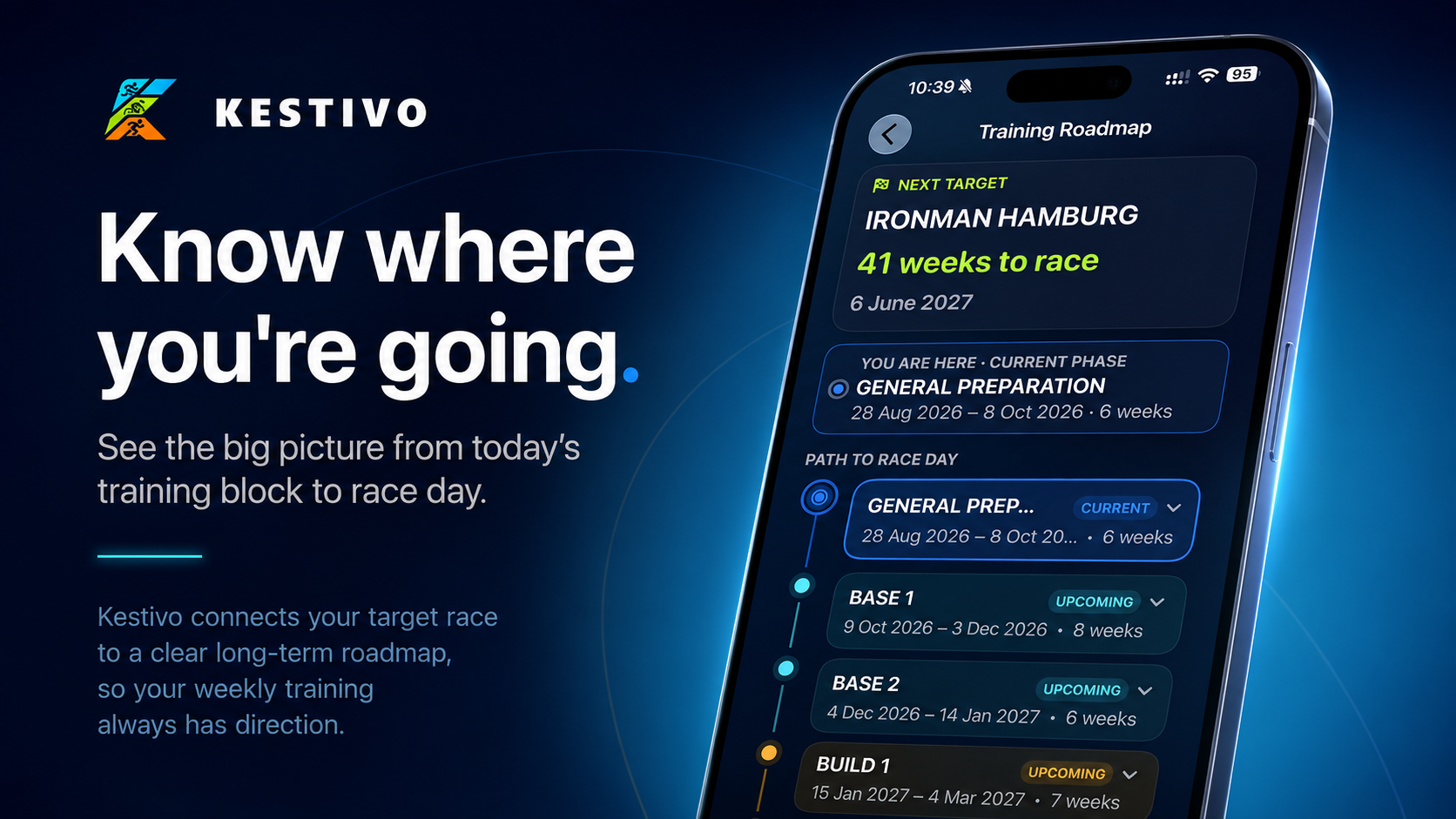
I'm building Kestivo around exactly this problem.
The idea is not to generate a long season plan once and then pretend the answer remains perfect for the next nine months. I want long-term direction and short-term decisions to stay connected without becoming the same thing.
- Athlete context
Race goals, availability, thresholds, equipment and preferences. - Training Roadmap
The long-term race direction and current phase. - Next-week planning
A structured week built from the Roadmap plus current evidence. - Validation and review
The proposal is checked, then the athlete decides. - Planned and actual training
What was prescribed and what actually happened remain separate facts. - Physiology context
Training-load evidence helps the next decision without pretending to be a complete readiness score.
The loop is now in private beta with selected athletes, including Roadmap planning, next-week generation, review and approval, planned-versus-actual presentation, completed-workout import and confidence-aware physiology.
The point of the beta is not to make the feature list look longer. It is to find out whether the planning holds up when real athletes bring real weeks into it.
Triathlon training plan FAQ.
How many weeks should a triathlon training plan cover?
That depends on the event, current fitness and training history. Long-term direction is useful, but detailed weekly decisions become less reliable the further into the future they are made.
How many sessions should a triathlete do each week?
There is no universal number. Frequency depends on race distance, experience, available time, recovery and which disciplines need the most attention.
Should every week include swim, bike and run?
Usually, but not necessarily in equal amounts. Discipline frequency should reflect race demands, ability, access and current priorities.
What should happen after a missed workout?
First decide whether the session is still important to the purpose of the week. It may be skipped, shortened or moved, but it should not automatically be added to the next open day.
Is Kestivo available now?
Yes, in private beta with selected athletes. Additional beta places will open gradually through the beta list.
Related Kestivo guides.
Help test race-oriented planning built for real life.
A small selected group is already using Kestivo with real training. More beta places will open gradually as the product develops from that feedback.
Selected athletes testing nowThis page covers general training-planning concepts. It is not medical advice.