Athletes often end up with one tool for planning, another for execution and another for completed training. The hard part is not collecting more data. It is keeping enough context together to make a better next decision.
Tracker, calendar and planning system are not the same thing.
At some point I realised I had built a small committee of apps. One recorded the workout, one stored the plan, one reminded me about it, and one helped me think about the next week. The committee rarely agreed.
Tracker
Answers: what happened? Distance, pace, power, heart rate and all the other facts we like staring at after a session.
Calendar
Answers: what was supposed to happen? Future workouts, dates, structure and whatever you moved around on Sunday evening.
Planning system
Gets the awkward question: okay, given all that, what should I do next?
Coaching layer
Explains why the recommendation makes sense and where the evidence is uncertain.
Logging a completed run and deciding whether tomorrow's threshold session still belongs are genuinely different jobs. One is bookkeeping. The other is judgement.
What I would actually check before choosing a training app.
I would ignore the size of the feature list for a minute and ask whether the basics connect properly. A race name in a profile is not the same thing as race-aware planning, and an "AI" button is not the same thing as a useful coaching decision.
| What to check | Weak version | What is actually useful |
|---|---|---|
| Race context | Race name stored as a note | Race date and current phase genuinely shape training |
| Availability | Fixed weekday template | The plan respects your real week |
| Intensity | Generic category targets | Power, pace and swim targets use your own thresholds when the evidence is reliable |
| Completed training | Separate activity feed nobody uses for planning | What you actually did becomes evidence for what comes next |
| AI output | Loose chat text | Structured drafts you can inspect and change |
| Control | Silent automatic changes | You review generated training before it becomes authoritative |
| Integration failure | The app becomes a decorative error screen | Manual creation and completion still work |
AI does not need a master key to your calendar.
I am building Kestivo around a review boundary on purpose. Generated training is a proposal, not a command. An AI model can be very good at composing a week and still be wrong about something only the athlete knows.
The deterministic layer protects hard constraints. Athlete review protects the messy human context no database can fully capture.
That is slightly less magical than "your plan updates itself while you sleep". I am fine with that. Trust is more useful than magic when the recommendation decides what you do with tired legs tomorrow morning.
Planned and completed training are two different truths.
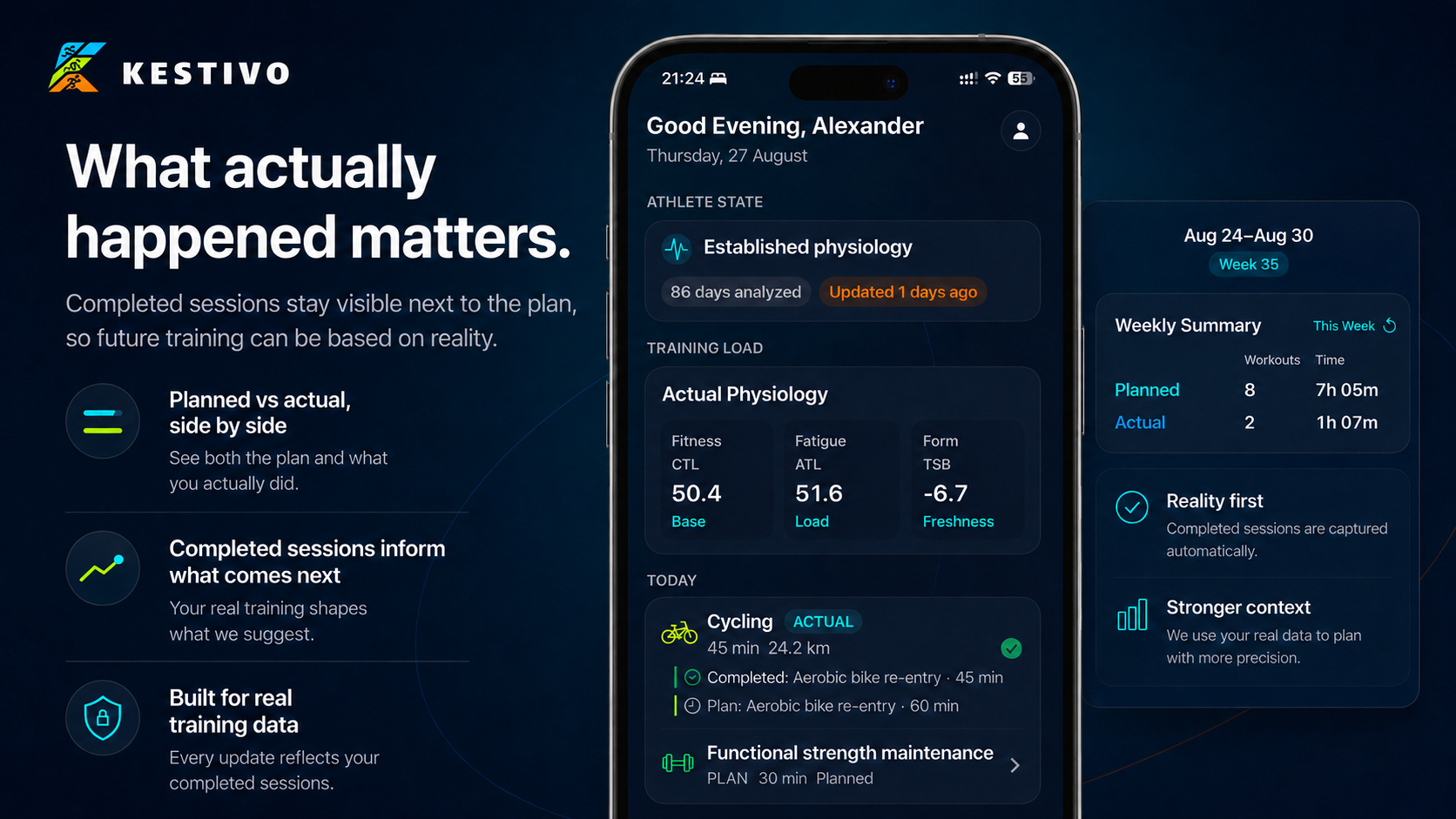
If the plan says 60 minutes and I ride 45, I do not want the app quietly changing history so the day looks tidy. The plan was 60. The ride was 45. Both facts are useful.
Kestivo keeps planned workouts and completed activities separate, then presents them together when the relationship is clear. If the match is ambiguous, it stays ambiguous rather than letting software guess because two timestamps happen to look convenient.
That sounds like a small data-model detail. In practice it is what lets the next planning cycle understand both intent and reality.
The four-tools problem is slowly becoming one loop.
The reason I started Kestivo was simple: I was tired of rebuilding the same training context across several tools every time I wanted to plan the next week.
- Build the athlete context.
Race, availability, zones, equipment, preferences and recent training. - Create the Roadmap.
Long-term race direction, so the weekly plan is not improvising. - Draft the next week.
Structured workouts based on the Roadmap plus current evidence. - Validate and review.
Check the proposal, then let the athlete decide. - Execute and record.
Import completed activities where available, or enter them manually. - Use reality next time.
The next request starts from what actually happened, not from a perfect fictional week.
The boring answer: Kestivo is still pre-beta.
The more useful answer is that quite a lot of the loop now works internally. Roadmap planning, next-week generation, athlete review and approval, planned-versus-actual presentation, completed-workout import on iOS, manual completion and confidence-aware training-load physiology are all in the product.
Planner stabilization. I do not need another twenty features before inviting athletes. I need the core coaching loop to be reliable enough that I would trust it with someone else's training, not just my own test account.
They are still a work in progress. The core planning workflow is deliberately designed so one missing bridge does not make the whole product useless.
Kestivo is not in the App Store yet. The waitlist is free, does not create an app account and does not promise a specific invitation date.
Related Kestivo guides.
Help test planning that connects the full loop.
Kestivo will begin with a limited athlete group after the planner stabilization gate is satisfied.
This page provides general product and training information. It is not medical advice.