Adaptive coaching is not the same thing as changing the plan.
You miss Tuesday. Thursday goes much harder than expected. Work removes Friday completely. Your long run feels unusually difficult. Or everything goes well for six weeks and you are clearly training at a different level from where you started.
A static plan can ignore all of that.
An overactive "adaptive" system can be just as bad. It can react to every workout, move sessions around constantly and make the plan impossible to understand.
Adaptive coaching uses the athlete's goal, training history, current context and recent execution to adjust upcoming training without losing the purpose of the larger plan.
Changing the plan is easy. Knowing what should stay unchanged is harder.
A training plan still needs something stable underneath it.
Imagine preparing for a marathon. The long-term goal does not become irrelevant because you missed Wednesday's run. You still need aerobic durability, long-run development, appropriate intensity and eventually race-specific work.
The same applies to triathlon. Missing one swim does not mean the entire build phase should be reconsidered.
Relatively stable
The race, the larger training phase, the main development priorities, progression toward race-specific work and the need for recovery.
More adaptable
Which day a session happens, whether a secondary workout survives, session duration, intensity and the balance between load and recovery during the next few days.
Otherwise the athlete does not have a training plan. They have a sequence of reactions.
What should an adaptive coach actually look at?
More data is not automatically better. I would rather have five useful facts than twenty numbers that happen to be available from a watch.
What was planned.
You need a reference point. If 90 minutes was planned and 55 minutes were completed, those are two different facts. You cannot understand the difference if you discard the original plan.
What was actually completed.
The calendar tells you what was supposed to happen. Completed training tells you what the athlete actually absorbed. Those should not be treated as the same thing.
Where the athlete is heading.
Training six months before a marathon should not look like training two weeks before it. The same athlete can need very different work depending on the current point in the build.
Real availability.
A theoretically perfect session that cannot be completed on that day is not a good prescription. Work, family, travel, pool access and available training time are part of the coaching problem.
Intensity and thresholds.
Pace, power, heart rate and swim CSS can make training more specific when the data is reliable. They should not make the software pretend it knows more than it does.
Recent load and recovery.
This matters, but I am wary of turning one readiness score into an answer to everything. Training load, fitness, fatigue, sleep and similar signals are evidence. They are not a substitute for the decision.
The most important adaptation may be doing nothing.
This is one of the less exciting parts of adaptive coaching.
A slightly slow easy run does not require a new training block. One missed recovery session probably does not require anything. A surprisingly good interval workout does not automatically mean every target should get harder next week.
If a system changes training whenever it sees a difference, it will eventually start reacting to noise.
I want adaptation to have a reason. Something happened that materially changes what the athlete can, should or needs to do next. If nothing meaningful changed, the plan should be allowed to survive.
Running makes the adaptive problem easier, and harder.
Kestivo started with triathlon because that is the planning problem I knew most directly. Triathlon also makes the complexity obvious. Swim, bike, run and strength all compete for time and recovery.
Running looks simpler because there is only one primary endurance discipline. But adaptive running planning has its own problems.
You cannot simply remove swimming and cycling from a triathlon plan and call the result a running coach.
A missed long run is not just an empty calendar slot.
Suppose Sunday was supposed to be a 1:45 long run and it did not happen. Moving it to Monday might put it directly before Tuesday's interval session. Moving the intervals might then disrupt the rest of the week.
Trying to "recover" both sessions can turn one missed workout into five days of compromised training.
Sometimes the correct adaptation is simply to lose the long run. That can feel wrong because the athlete sees an important session disappear. But preserving every workout is not the same thing as preserving the training objective.
Running load is not only cardiovascular load.
A runner can be aerobically capable of more training before the musculoskeletal system is ready for it. Mileage progression, long runs, hard-running frequency and consecutive demanding days therefore matter differently from adding another easy cycling session.
The event changes the answer.
A 10K runner, half-marathon runner and marathon runner should not receive the same adaptation simply because their recent training history looks similar. Race distance changes what needs protecting.
Dedicated running planning should eventually consider the target race and distance, current weekly running volume, long-run progression, recent completed training, threshold pace, available training days, hard-session spacing, experience, durability and the demands of the event.
Running is a planned expansion beyond Kestivo's initial triathlon focus. I do not want that to mean selecting "Run" and feeding the same planning logic fewer sports. It should understand running as running.
AI helps, but adaptive coaching is not the same thing as AI coaching.
AI is useful here because the decision contains context. There may be a race, several weeks of training, changing availability, completed sessions, athlete preferences and a question about what should happen next.
That is exactly the sort of problem where a language model can help reason across multiple inputs.
But I do not think the model should own everything.
- Dates should be dates.
- Unavailable days should remain unavailable.
- Training should stay inside the planning window.
- The system should not invent a threshold because one is missing.
- A generated week should not silently overwrite the athlete's calendar.
Adaptive coaching becomes less impressive as a marketing sentence when you add those safeguards. I think it becomes much more useful as a product.
Adaptation is not the same thing as automatic rescheduling.
Imagine you miss a threshold run.
An automatic scheduler can find the next empty day and move it there.
An adaptive coach should ask a different question: does this workout still belong in the week?
The answer depends on what comes next. If tomorrow is easy and there is plenty of recovery afterward, moving it may be fine. If tomorrow already contains another hard session, shortening or dropping the missed workout may be better.
Where Kestivo fits today.
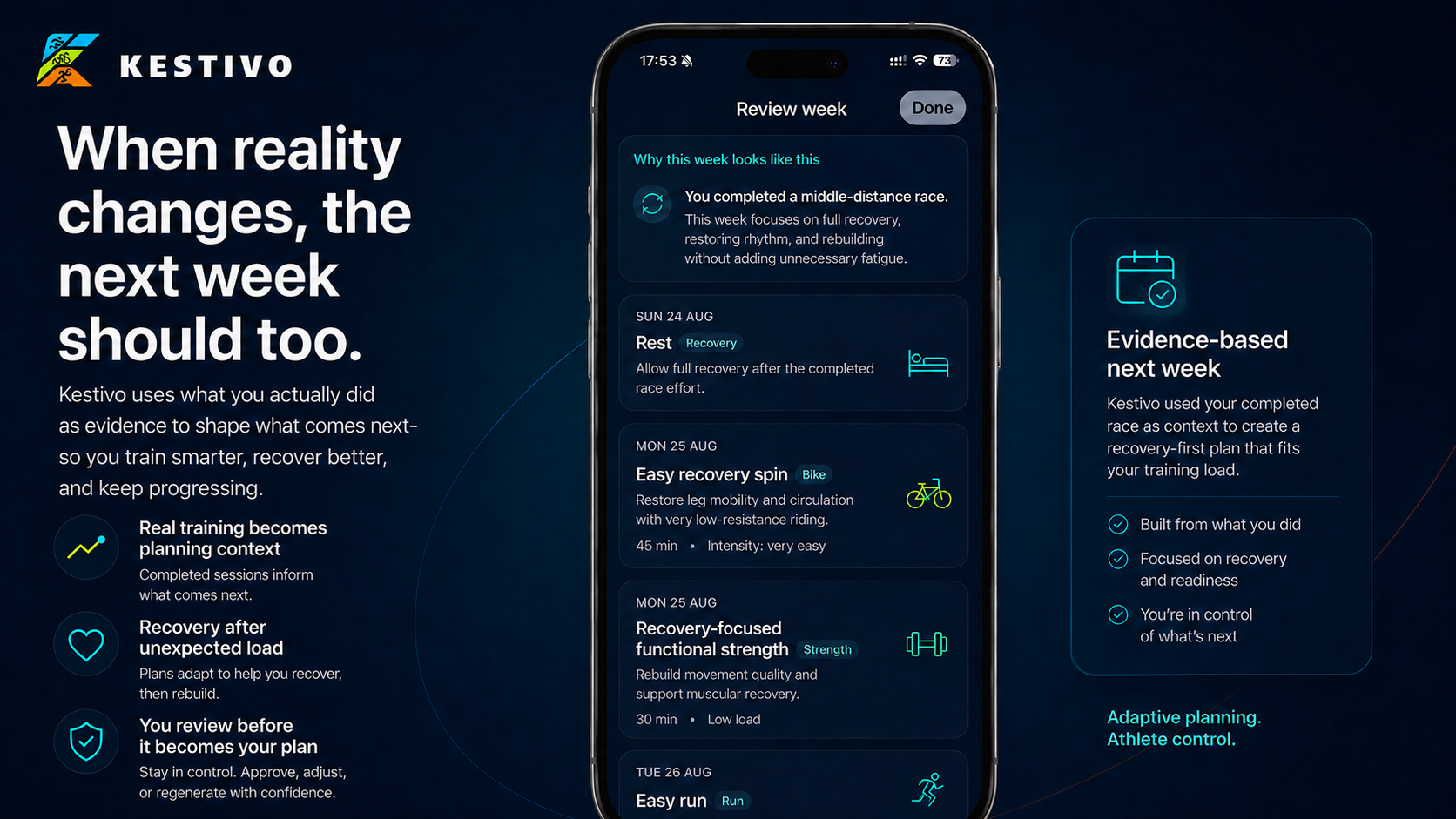
Kestivo is being built around the planning loop rather than around automatic calendar changes.
- Understand the athlete.
Race goals, availability, zones, preferences, equipment and training history form the planning context. - Keep a longer-term direction.
The Training Roadmap describes the progression toward the target race. - Plan the upcoming week.
Detailed training is created close enough to execution that recent reality can matter. - Compare plan and actual training.
What was planned and what was completed remain separate facts. - Validate before changing anything.
Generated training has to pass deterministic checks. - Keep the athlete involved.
The proposal can be reviewed before it becomes active training.
The adaptation layer is the part I am most interested in developing further. Not because I want Kestivo to change training more often, but because I want it to get better at knowing when a change is actually justified.
Triathlon is the first proving ground. Running is a natural next one.
The goal is not a perfect plan.
I do not think a perfect training plan exists.
Even if one did, it would probably stop being perfect by Wednesday.
The better goal is a plan with enough structure to create progression and enough flexibility to survive contact with an actual athlete's life.
That applies whether you are training for your first half marathon, trying to improve a marathon time or preparing for a long-distance triathlon.
The plan provides direction. Reality provides new evidence. Good coaching connects the two.
That is what I mean by adaptive coaching.
Adaptive coaching FAQ.
What is adaptive coaching?
Adaptive coaching uses changes in training, availability and athlete context to influence upcoming training while preserving the larger goal and progression of the plan.
Is an adaptive training plan the same as an AI training plan?
No. AI can help interpret context and generate recommendations, but adaptation also requires stable planning rules, reliable data and decisions about when not to change the plan.
What happens if I miss a workout?
That depends on the importance of the workout, what follows it, the current training phase and available recovery. The correct decision may be to move it, shorten it or simply leave it missed.
Can an adaptive running plan change my weekly mileage?
Potentially, but volume should not change simply because one workout was unusually good or bad. Recent training, progression, experience, race demands and recovery all need to be considered.
Does adaptive coaching mean my plan changes every day?
It should not. Frequent unnecessary changes make training harder to understand and can destroy useful progression. Adaptation should respond to meaningful evidence.
Will Kestivo support runners?
Running is a planned expansion beyond Kestivo's initial triathlon focus. The goal is dedicated running planning rather than simply using the triathlon system with swimming and cycling removed.
Can adaptive coaching replace a human coach?
No. Software can help with repeated planning decisions and connect more training context, but it cannot reproduce direct observation, individual judgement or the personal relationship of a good human coach.
Related Kestivo guides.
Help test whether the plan survives real training.
Kestivo is being built around athletes who do not have perfect weeks. The private beta will test the planning loop with real training, real missed sessions and real changes in availability.
This page covers general training-planning concepts. It is not medical advice.