
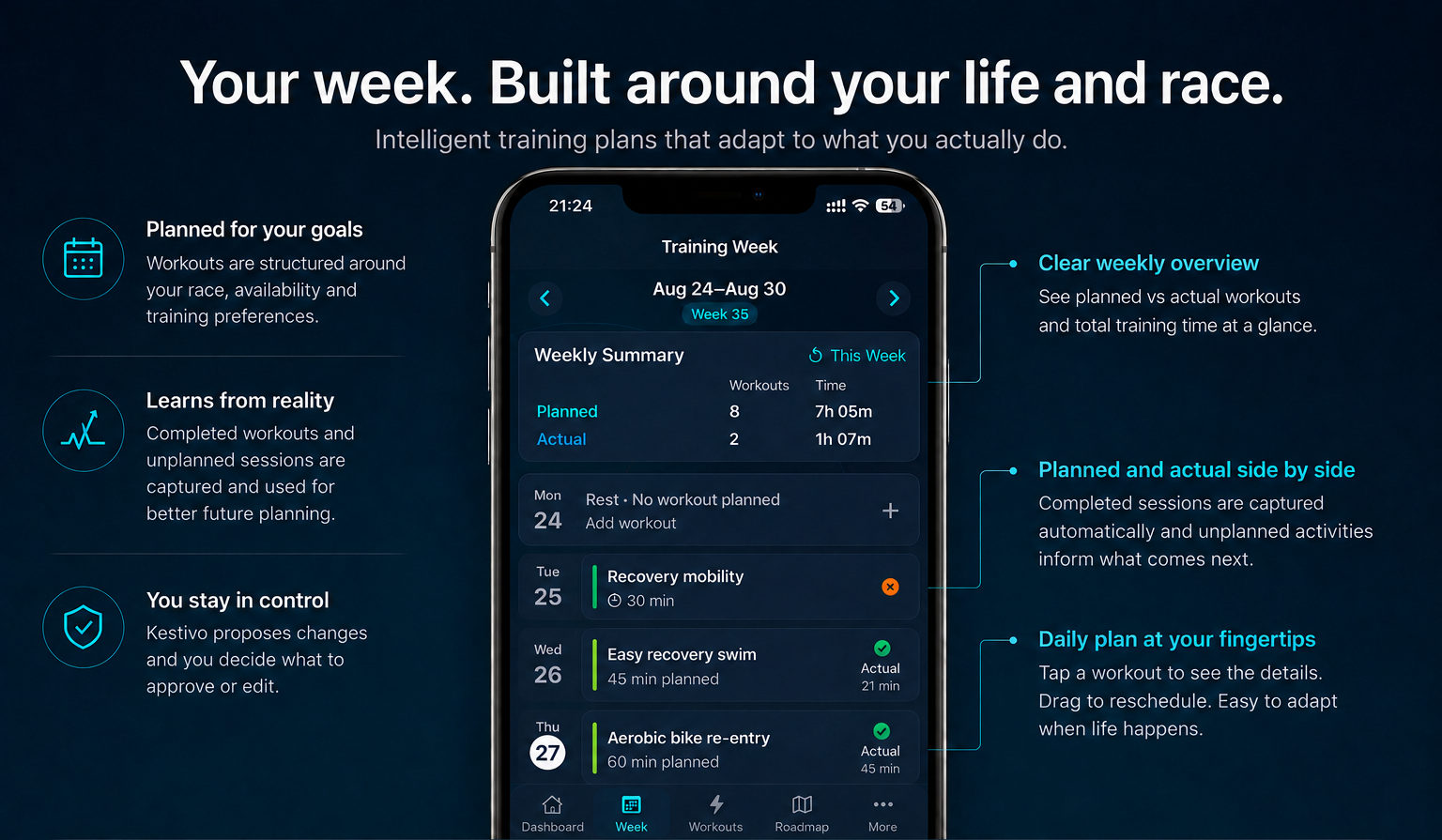
First identify why it was missed, the key objective of the week and what is already scheduled. Sometimes the best response is to do nothing to the calendar.
Was it a calendar conflict, fatigue or something else?
A work meeting that runs late and a session missed because you feel ill are not the same training problem. Yet many plans treat them identically, as empty slots to refill.
Ask why the workout did not happen. Logistics might call for a small scheduling adjustment. Heavy fatigue may call for recovery or reduced intensity. Illness, pain, dizziness or unusual symptoms change the question entirely; a generic article cannot clear you to train, and persistent or concerning symptoms warrant professional advice.
Then consider whether the missed session was a key stimulus for your current phase, an easy support session, or simply another opportunity to accumulate endurance. You are deciding which training purpose to preserve, not trying to achieve 100% calendar completion.
Protect the purpose of the week, not the original timetable
Imagine a build week with one race-specific long ride, one quality run, two swims, a shorter easy ride and recovery space. The missed easy ride has a different cost from missing the long ride that was intended to practice fueling and maintaining race effort.
- Easy supporting session: Often safe to drop rather than crowd the remaining week.
- Key but repeatable workout: Consider a shorter version if it fits the following days and recovery needs.
- Long race-specific session: Reassess whether it can move without colliding with the long run or creating excess fatigue.
- Missed recovery day: Do not replace rest with extra work simply because a dashboard shows an empty calendar slot.
There is no universal hierarchy. A swim-limited athlete preparing for their first open-water event may rightly prioritize a swim that another experienced athlete would skip.
A missed Thursday bike workout before the weekend
Consider an illustrative athlete preparing for a middle-distance race. Thursday should contain hard bike intervals, Saturday a three-hour endurance ride with a short optional brick, and Sunday an easy long run. Thursday disappears because of work.
| Reaction | Tradeoff |
|---|---|
| Push hard intervals to Friday | May place hard work too close to Saturday's long ride and weaken the key session. |
| Move the long ride instead | Possible only if weekend availability and the run/recovery structure allow it. |
| Drop the intervals this week | Often a reasonable choice when long-ride quality and recovery matter more than full session count. |
| Shorten or lower the intensity of another session | Could preserve a small stimulus without simply stacking all missed work. |
Which response is right depends on load, phase, experience and how the athlete actually feels. The key is that none of the options should happen blindly.
Three ways athletes turn one missed session into a bad week
1. Double up without checking the next 48 hours
Moving a hard bike session beside an already demanding run can accumulate fatigue even when the total weekly training time stays unchanged.
2. Chase a weekly-hour target at any cost
A planned ten-hour week is not a debt that must be repaid by Sunday night. Training effects depend on distribution, intensity, current capacity and recovery.
3. Pretend a missed session was completed
Keep what was planned separate from what actually happened. Accurate records let the next week's decisions use real evidence instead of an idealized training history.
A conservative five-step response
- Identify why the session was missed and whether recovery or symptoms limit training.
- Mark it accurately as missed or not completed rather than changing your history.
- Identify the week's key purpose, including race phase and discipline needs.
- Look forward at demanding sessions, recovery and fixed life constraints before moving anything.
- Choose one response: skip, reduce, replace or reschedule. Do not automatically make up the complete workout.
If several sessions disappear, stop treating them as isolated events. Review whether the week still supports the intended block. Sometimes the better answer is to simplify next week, not to add complexity to the current one.
What a training app should remember after the week ends
A useful planning system should know the race direction, actual availability, completed activity, missed training and relevant uncertainty. It should not assume that missing data means fresh legs, and it should not manufacture intensity targets when thresholds are unknown.
In Kestivo's current iOS private beta, actual training contributes context for upcoming weekly planning. Athletes can review proposed training before activation. The app is not continuously rescheduling active workouts on its own, and broader automated missed-workout coaching remains ongoing product development.
That distinction matters more than the word AI. Good adaptation means making a defensible new decision from real evidence. For the wider philosophy, see our adaptive triathlon training guide.
Frequently asked questions about missed workouts
Should I do two workouts tomorrow?
Only if a double day was already appropriate to your training history, recovery and available time. Doubling merely to replace a missed session is rarely a sound default.
Will missing one workout ruin my race build?
One ordinary missed session rarely determines a season. Repeated gaps can matter, but the response should address the cause and overall progression.
What if I missed a workout because I am ill?
Do not apply a generic make-up rule. Pause hard training and seek appropriate medical guidance when symptoms warrant it, especially with fever, chest symptoms or unusual exertional responses.
Does an adaptive training plan mean moving everything automatically?
No. Sensible adaptation can mean retaining the rest of the schedule unchanged and using the missed-session evidence when planning the next week.
Related Kestivo guides.
Make the next training week more useful.
Kestivo is an iOS private beta for selected athletes. It uses training context to propose workouts; the athlete reviews what becomes the plan. Features are still developing, and access is limited.
Selected athletes testing nowGeneral training and product information only. Training examples are illustrative, not individualized medical or coaching prescriptions. Product descriptions reflect publicly available vendor documentation as of 12 October 2026 where linked.